

In-Home Support for Adults With Disabilities for Alabama & Florida Families.
They Came Home Because You Refused to Let the System Define Them.
Relationship-based in-home support for adults with physical or intellectual disabilities across the gulf coast of Alabama and Florida.
Direct line. No call center, no hold queue. In-home assessment: $25 — waived when care begins within 48 hours.
We build the care plan around the person, not just the diagnosis.
In-Home Support for Adults With Disabilities for Alabama & Florida Families.
They Came Home Because You Refused to Let the System Define Them.
Relationship-based in-home support for adults with physical or intellectual disabilities across the gulf coast of Alabama and Florida.
Direct line. No call center, no hold queue. In-home assessment: $25 — waived when care begins within 48 hours.
We build the care plan around the person, not just the diagnosis.
Years Serving Families
Caregiver - Consistency By Design
Client Cap - Real Oversight
Term - Built By Design
Why families bring their loved one home from group care.
You brought them home for a reason. This service is built around that reason.

Adult Disability Home Support is built around that standard. Consistent caregivers matched for disability-specific experience and personality fit. A care plan driven by your loved one's actual preferences and communication style. The same faces, the same schedule — week after week, not until the next round of turnover.
The group home promised structure, supervision, and professional care. What it delivered was a revolving door of caregivers who never stayed long enough to learn the person in their care. The routines that took years to build started slipping. The personality that makes your loved one who they are started going quiet.
That is not an anomaly. It is what happens when the model prioritises coverage over consistency — when the client is a placement rather than a person.
You brought them home because you knew the difference. The decision was right. The challenge now is building support that holds the same standard you do: someone who shows up reliably, learns how your loved one communicates, respects what they can do rather than focusing on what they cannot.
"They Came Home Because You Refused to Let the System Define Them."
The decision to bring them home was right. Building care that holds that same standard — consistent, matched, long-term — is what Adult Disability Home Support exists to do.
Who Adult Disability Home Support Alabama Serves
If the situation below sounds familiar, you are in the right place.
This service is right for your situation if:
- Your loved one is an adult with a physical disability, intellectual disability, or both — including cerebral palsy, Down syndrome, traumatic brain injury, or similar conditions
- They require assistance with daily living tasks: bathing, dressing, transfers, toileting, meal preparation, mobility support
- They are currently living at home and you need consistent, scheduled support to keep that arrangement safe and sustainable
- They have recently returned home from a group home or institutional setting and need stable, relationship-based care to re-establish routine
- You are planning ahead for long-term support — including what happens when family caregivers are no longer able to oversee care
This service may not be right fit if:
- Your loved one requires licensed nursing care or skilled medical intervention
- Behavioural health support from a licensed mental health professional is needed
- The level of physical or medical complexity exceeds non-medical home care scope
- Your loved one is located outside Baldwin or Escambia County, Alabama, or Escambia County, Florida
Not sure whether the level of support your loved one needs fits within non-medical home care? Call us. We will ask the right questions and tell you honestly — including if the situation calls for something beyond what we offer.
Disability Caregivers Who Know Your Loved One as a Person.
Not just what they need help with.

The match is built on direct observation
Before any caregiver begins, we conduct an in-person assessment that includes direct time with your loved one. Not just a conversation with you about them — actual observation of and interaction with the person receiving care.
Same caregiver. Same schedule. Non-negotiable.
Once care begins, consistency is non-negotiable. Same caregiver. Same schedule. Minimal rotation. For adults whose wellbeing depends on predictability and familiar presence, turnover is not an inconvenience — it is a direct harm.
Your loved one directs their own care
The tasks are not the point. The point is the relationship — a caregiver who engages your loved one as the adult they are, takes direction from them about their own preferences, and treats the time spent together as time that belongs to the client.
How Serenity Heart's Disability Home Support Differs
These are not promises. They are the decisions Serenity Heart has made about how to run this agency — operational choices that cost something and exist because the work requires them.
The families who call for adult disability support have usually been through a system that made the opposite choices. These three commitments exist specifically in response to what that system gets wrong.
Consistency is built into the model, not bolted on.
Caregiver turnover is a predictable outcome of how most agencies are structured. Serenity Heart caps total client load at 50 families so that Antonio and Angelia can oversee every placement directly. That cap is what makes genuine caregiver consistency possible. They know who is in every home, when something is at risk of changing, and they act before turnover becomes disruption.
The care plan belongs to your loved one.
Most care plans are built from what family members report. Serenity Heart's starts with direct observation of and interaction with the client during the in-person assessment. Your loved one's preferences, communication style, and daily routines are documented as the foundation of the plan — not as a supplement to it.
Serenity Heart is thinking about the long term.
Many families who call for adult disability support are not just solving for today. They are thinking about what happens to their loved one as the family's capacity changes. Serenity Heart builds the care relationship with that future in mind.
These are Serenity Heart's operational commitments — built into how the agency is structured, not into how much time any one person puts in.
Disability Home Care Assessment: We start with the person
Not to evaluate what they cannot do. To understand who they are.

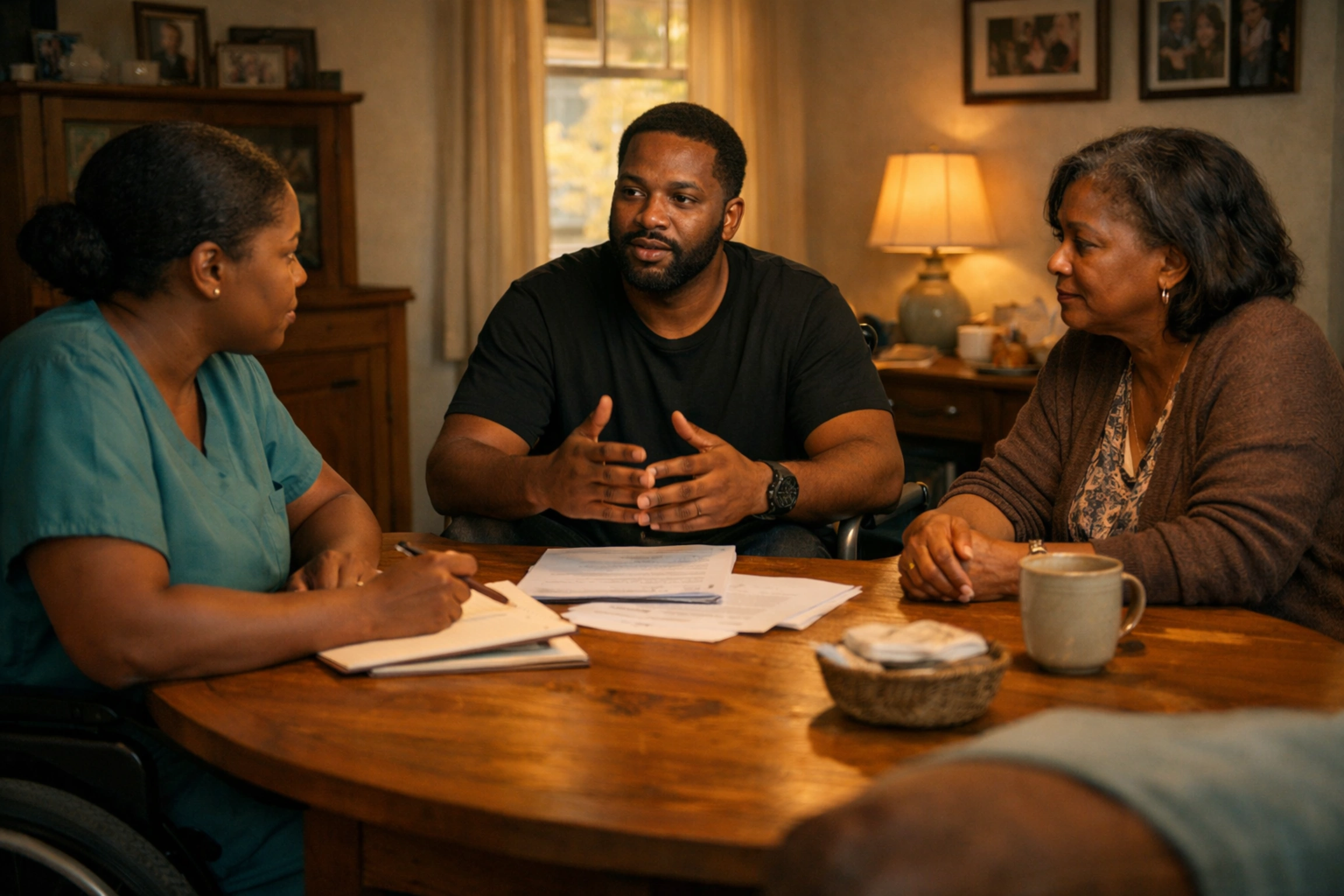
Antonio or Angelia comes to the home before care begins. The assessment involves direct time with your loved one — not a form, not a proxy conversation with family, but actual observation and interaction. We are learning how they communicate. How they navigate their space. What their routine looks like and what happens when it is disrupted.
From everything Serenity Heart learns, the match is made. Disability-specific experience, physical skill, personality fit — and the longer-term question: is this a caregiver who could build the kind of relationship that holds over time?
Assessment fee: $25 — Waived if care begins within 48 hours
Adult Disability Home Support: Family outcomes
What Serenity Heart has watched happen, consistently, when the right match is in place.
The families who call Serenity Heart for adult disability support are not people who gave up on their loved one. They are people who fought the system, brought their loved one home when it failed, and are now trying to build something better. They are also, quietly, exhausted.
Within weeks of consistent, matched care, the pattern that fell apart in the group home starts to reverse.
Routines re-establish. The person begins to re-emerge. The family notices it first in small things — engagement, appetite, the return of humour or personality traits that had gone quiet.
The family changes too. The parent who has been doing unsafe transfers alone stops being at physical risk. The one who has not slept properly in months starts to. The conversations about the future — the ones nobody wants to have — start to feel slightly less impossible because there is now a person in that home they actually trust.

"I love bringing something new to the table — different strategies of care for elderly and disabled people. Just being able to help them function in their home so they don't have to go into a facility."
Antonio Ankum, Owner
What Adult Disability Home Support costs and how families cover it.
We will be direct about cost. That conversation starts on the first call.
Pricing reflects the level of care and scheduling your loved one needs — the specific daily living support required, the number of hours per week, and whether coverage needs to grow over time. Serenity Heart does not bury rates.
Direct Pay
Serenity Heart currently accepts private pay.
Poarch Creek Elder Services
May be eligible for services through the Elder Services program. Call us to find out.
Medicaid / Medicare - In active pursuit
We are actively pursuing accreditation for Medicaid and Medicare - 2026 target.
Start Adult Disability Home Support. We're Here for the Long Term.
The next step does not require a plan. Just tell us about the person who needs care - who they are, what their situation looks like right now, what you have already been through.
No pressure. Just a straight answer.
Disability Home Support questions answered directly
The questions that carry the most weight. Answered without hedging — because you have probably already been given enough non-answers.
We have been through constant caregiver turnover before. How do you ensure the same person shows up?
Serenity Heart keeps total client load capped at 50 families. That is not a coincidence — it is the operational decision that makes caregiver consistency possible. Antonio and Angelia know every placement directly. When a caregiver situation is at risk of changing, they know before it becomes disruption and they act. Serenity Heart cannot promise that caregivers never change. What can be promised is that consistency is a structural priority, not a talking point.
Our loved one is an adult with their own preferences. How do caregivers take direction from them — not just from us?
his is one of the most important questions a family can ask. Your loved one is an adult. Their preferences about how they want to be cared for, what their day looks like, and how they want to be spoken to are not secondary to the family's preferences — they are the primary input. Serenity Heart documents those preferences directly during the assessment, through observation and interaction with the client. The caregiver is briefed on them before they begin.
Their needs have changed over the years and will keep changing. How does the care plan handle that?
The care plan evolves with the person. When something changes — a new physical limitation, a shift in routine, a change in the level of support needed — you call Serenity Heart and we adjust. You do not start over. You do not re-explain your loved one's full history to someone who has never heard it. Because the client load is capped and Antonio and Angelia know every situation directly, a change in condition is a conversation, not a new intake process.
We are getting older and worry about who will look after them when we can no longer oversee everything. Can Serenity Heart be a long-term partner?
Yes. And we want you to know we understand why you are asking. The families who call for adult disability support are often thinking about two things at once: what they need today, and what their loved one will need when the family's capacity to oversee care changes. Serenity Heart builds the care relationship with both in mind.
Our loved one has specific communication needs. How do you make sure a caregiver actually understands them before they start?
The in-person assessment is where this work begins. Antonio or Angelia spends direct time with your loved one — observing how they communicate, what they respond to, what creates frustration or confusion. The family is asked to walk through everything learned over years of caring for them: the language that works, the approaches that do not, the non-verbal signals that matter. All of that goes into the caregiver profile before anyone is matched.